
NOT IF two crucial elements are attended to:
1. PURPOSE: The identification of the purpose of the program -see Fig. below.
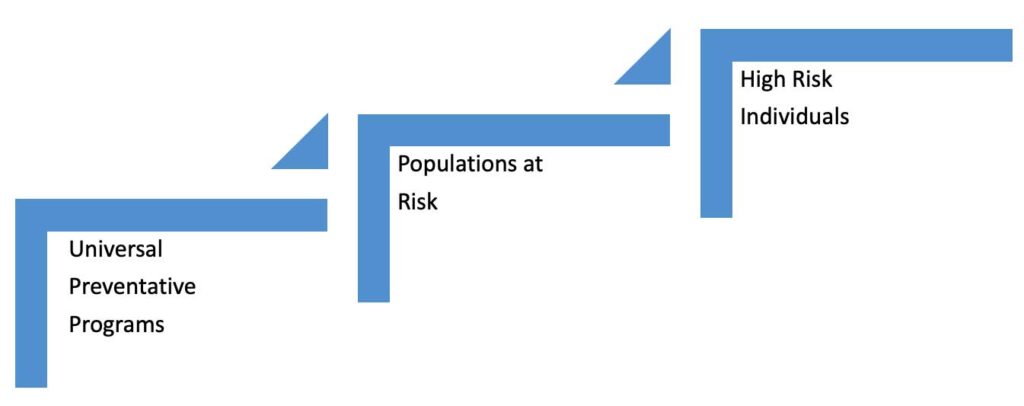
- Universal Programs: targeted to the whole population group that has been identified as at risk e.g. childhood measles immunization
- Populations at Risk. interventions are directed towards individuals or sub-groups of a population known to be at risk of developing problems e.g. literacy programs
- ‘High Risk’ Individuals. Programs are directed specifically toward high risk individuals who may already be presenting with signs or symptoms e.g. programs to prevent depression in children.
2. QUALITY ASSURANCE AND IMPLEMENTATION
…. the magnitude of mean effect sizes are at least two to three times higher when programs are carefully implemented and free from serious implementation problems than when these circumstances are not present.”( Durlak & DuPre, 2008, p.340)
Transferring effective anti-bullying (eg PEACE Pack) and wellbeing programs (eg Big Talks for Little People) into real world settings such as schools and classrooms is a challenge.
There are 5 key elements quality assurance and implementation to attend to:
• Adherence (a.k.a. fidelity, compliance) is the degree to which the core components of the program are delivered as intended e.g. relevant audio visual resources were shown and discussed.
• Dosage refers to how much of the original program has been delivered and the quantity of the program to which participants have been exposed e.g. were all identified lessons delivered.
• Participant responsiveness is the degree to which the program motivated students and the extent to which participants engaged with the program.
• Quality of delivery relates to the iteacher’s program delivery skills and how well different program components have been conducted e.g. was relevant teacher PD undertaken.
• Program differentiation is the extent to which a program’s theory and practices can be distinguished from other programs (i.e. program uniqueness) so that there is no contamination from other programs
Organizations such as schools and sports clubs are complex organizations posing significant challenges for the delivery and evaluation of health promotion initiatives. The systems approach (Shute & Slee, 2021) argues that interventions should be nuanced to clearly identify the purpose, quality assurance the developmental appropriateness and individual and social and cultural factors.
Please visit our websites : www.caper.com.au and <bigtalkslittlepeople.com>
References
Shute, R & Slee, P.T. (2021). School bullying and marginalization. Harmonizing paradigms. Springer.